How to Use a 4-20mA Signal Generator
For many UK maintenance engineers, a 4-20mA loop fault starts with a simple complaint: the PLC value does not match the process, a display is stuck, or a valve is not moving as expected. The difficult part is not proving that something is wrong. The difficult part is proving where the fault sits.
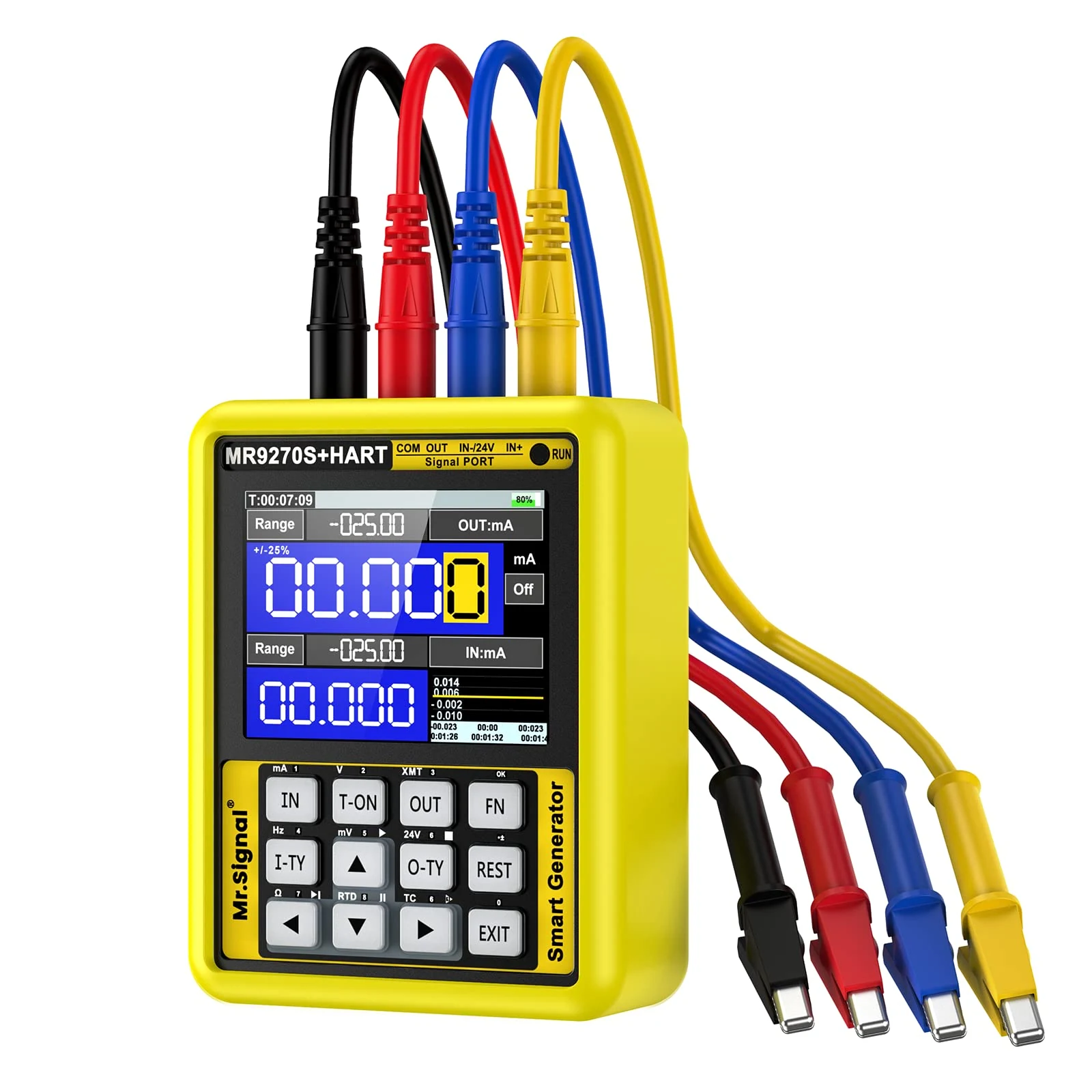
A 4-20mA signal generator helps because it creates a known signal. Instead of relying on a live transmitter, changing process condition, or removed PLC output card, a technician can send a controlled 4mA, 12mA or 20mA signal and watch how the receiving system responds. The MR9270S+ HART 4-20mA Multifunction Signal Generator is designed for this kind of process loop testing, with support for current, voltage, millivolt, frequency, thermocouple, RTD, HART and Modbus-related checks where the connected setup supports them.
In a typical UK plant room, workshop or facilities site, the first question is usually: is the controller input healthy? A signal generator is useful because it lets you test the input independently of the field transmitter. If the controller responds correctly to a known signal, the transmitter, sensor, loop wiring or field termination becomes the next area to inspect. If the controller does not respond correctly to a known signal, the issue may be with the input card, scaling, configuration or wiring at the panel.
Before connecting anything, confirm the circuit. Check the drawing, instrument tag, terminal markings and expected signal type. Do not assume every loop is wired the same way. Some loops are powered by the PLC or control system. Others rely on the field device or a separate supply. Source/sink, active/passive and polarity questions matter because a correct-looking connection can still give a zero reading if the loop power arrangement is wrong.
For a basic output check, select the current output mode before connecting the test leads. Connect according to the manual and the loop wiring. Start with 4mA. On a correctly scaled input, this should show the low end of the process range. Next, output 12mA for a mid-scale check. This is useful because it proves the response is not simply jumping between two ends of the range. Finally, output 20mA and confirm that the receiving device reaches high scale.
These three values are practical because they give a quick low, mid and high check. A pressure loop scaled from 0 to 10 bar should show roughly 0 bar at 4mA, 5 bar at 12mA and 10 bar at 20mA. If the values are reversed, offset or compressed, the problem may be scaling rather than hardware. If the display is unstable while the signal generator output is stable, check terminals, shielding, grounding, cable routing and input configuration.
The MR9270S+ HART is also useful when a transmitter reading appears unreliable. A technician can remove the transmitter from the question temporarily and use a known output to see whether the receiving device behaves. This helps reduce unnecessary part swapping, which matters when a site is under pressure to restore a process quickly.
Do not use the device as a mains voltage tester. It is for signal testing and process calibration. If the circuit, power source or terminals are unclear, stop and check the manual and site procedure before continuing.
Final checklist
- Confirm the loop is 4-20mA before testing.
- Check loop power, polarity and terminal position.
- Select the correct mode before connecting.
- Test 4mA, 12mA and 20mA.
- Compare expected and actual controller values.
- Record the result for the maintenance log.
- Do not connect to unsupported or mains voltage circuits.
FAQ
What is a 4-20mA signal generator used for?
It outputs known current values so technicians can test PLC inputs, displays, controllers and process loop behaviour.
Can the MR9270S+ HART output 4-20mA signals?
Yes. It is designed for current output and process loop testing.
Why test 4mA, 12mA and 20mA?
They represent low, mid and high points in many process loops, making them useful for checking scaling and response.
Can it replace a multimeter?
No. A multimeter measures values, while a signal generator creates known test signals. Many technicians use both.
Is it suitable for mains voltage testing?
No. It is for process signal testing and calibration, not mains voltage testing.
Ready to test 4-20mA process loops?
Shop MR9270S+ HART Signal Generator